
Entra ID Auth for ChatGPT MCP Servers with Datawiza Agent Gateway
Overview
This tutorial shows how to add Microsoft Entra ID (formerly Azure AD) authentication to an existing MCP server using Datawiza Agent Gateway — without modifying the server itself.
Datawiza Agent Gateway sits in front of your MCP server, handles the Microsoft Entra ID login flow, validates the user, enforces access policy, and forwards only authenticated MCP traffic to the backend. Your MCP server stays focused on its tools and never needs to implement enterprise OAuth.
Architecture
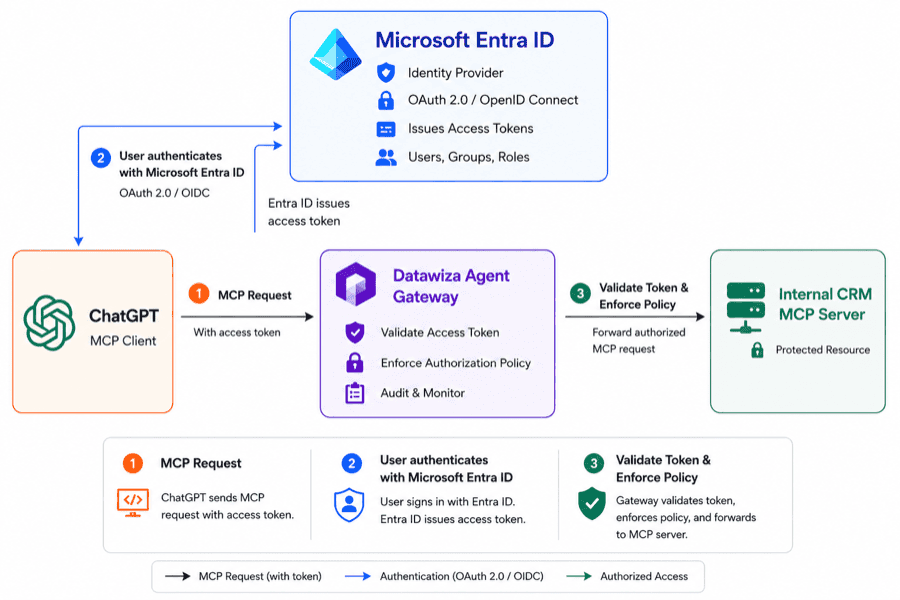
MCP over HTTP supports authorization at the transport layer. Protected MCP servers can require OAuth-style bearer tokens before granting access to tools. Since authorization is optional in the MCP spec, many internal servers skip it entirely — which is exactly where a gateway pattern adds value.
What You Will Build
By the end of this tutorial you will have a Datawiza-protected public endpoint sitting in front of your existing internal MCP server:
https://crm-mcp.company.com/mcp     ← protected endpoint ChatGPT connects to
http://internal-crm-mcp:3000/mcp    ← your existing MCP server (stays internal)
ChatGPT connects only to the protected endpoint. The internal MCP server is unreachable from outside your network.
The examples throughout this tutorial use a sample internal CRM server as the backend. This is illustrative — you will substitute your own MCP server. The sample server exposes three tools:
| Tool | Description |
|---|---|
get_customer_profile | Retrieve a customer's profile by ID |
list_customer_orders | List recent orders for a customer |
create_support_ticket | Open a support ticket on behalf of a customer |
Why This Pattern Matters
Many MCP servers are easy to build but do not include enterprise-grade authentication. This is risky when tools expose CRM records, orders, tickets, finance data, or internal APIs.
With Datawiza Agent Gateway, responsibilities stay separate:
- MCP server developers build business tools.
- Identity teams manage authentication and access policy.
- ChatGPT users authenticate with Microsoft Entra ID before any tool is available.
Prerequisites
- A Microsoft Entra ID tenant
- Permission to create Entra app registrations (this tutorial registers two: a resource app and a client app)
- A Datawiza Agent Gateway Console (DAGC) account
- A Linux host reachable from the internet on port 443 to run the gateway container
- Docker and Docker Compose installed on the gateway host (the setup script in Step 2.5 can install these for you)
- A public hostname for the protected MCP endpoint
- A TLS certificate from a trusted CA for that hostname
- An existing MCP server accessible on your internal network
- A ChatGPT Plus, Pro, Business, or Enterprise plan with custom MCP connectors available (some plans gate this behind a Developer mode setting — see Step 3)
Step 1: Register Apps in Microsoft Entra ID
MCP authorization needs two separate app registrations:
- A resource app that represents the protected MCP server itself — it exposes the API and the scope ChatGPT requests.
- A client app that represents ChatGPT — it's what a user actually signs into, and it holds the redirect URI and requests the resource app's scope on the user's behalf.
Keeping them separate is standard OAuth practice: the resource app is never involved in a browser redirect, and the client app never defines API scopes.
1.1 Register the Resource App
In the Azure portal, go to Microsoft Entra ID > App registrations.
Click New registration and fill in:
Field Value Name Datawiza CRM MCP GatewaySupported account types Single tenant Redirect URI Leave blank — this app never signs in a user directly 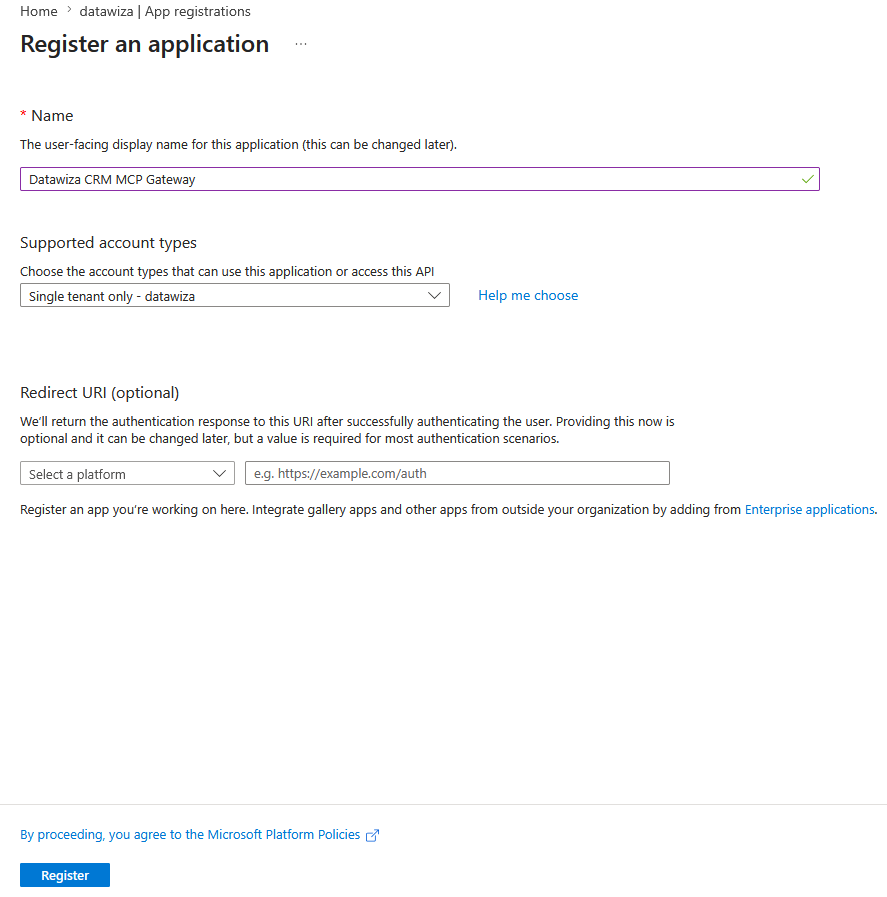
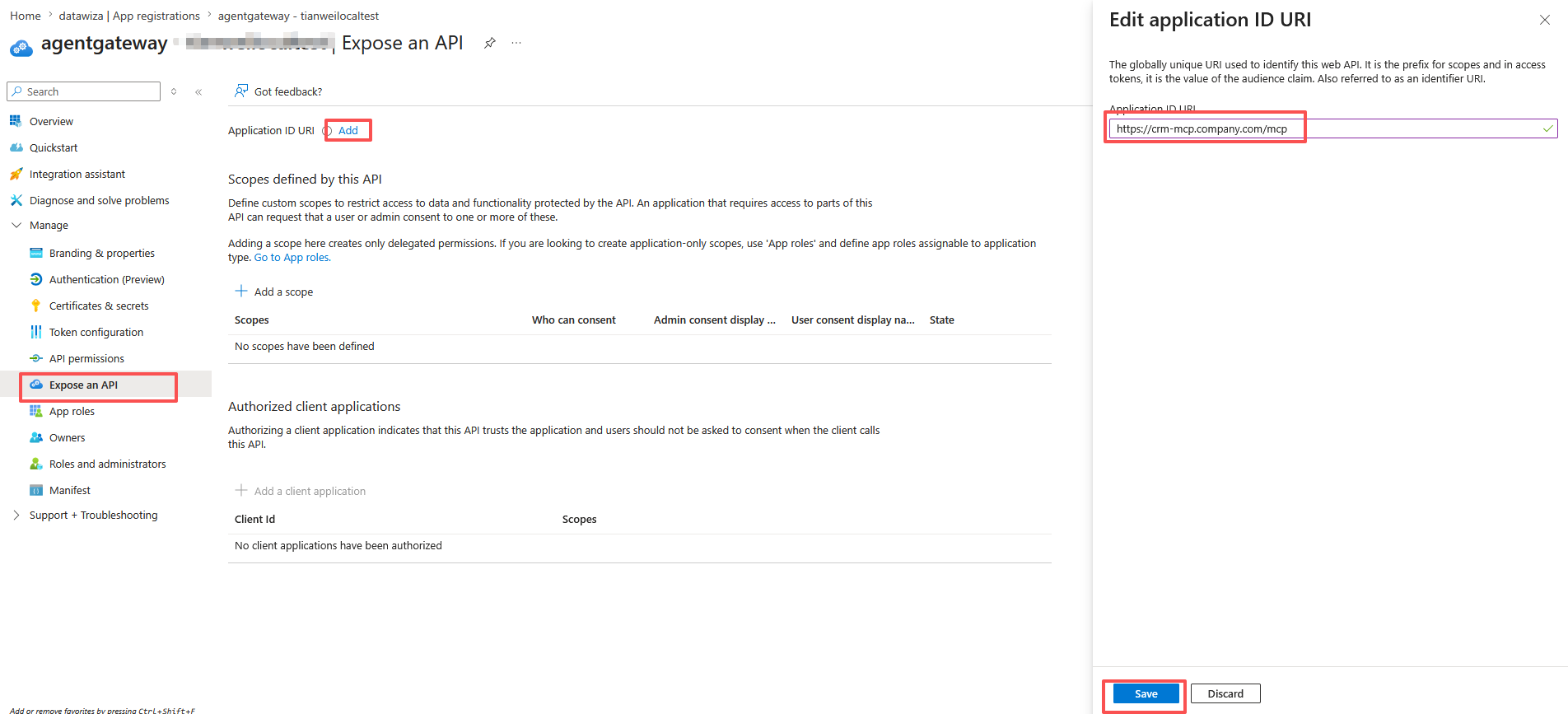
Configure the Application ID URI to match the protected MCP endpoint. ChatGPT requests the MCP server's URL as the
resource, and Entra ID rejects the request withAADSTS9010010if thatresourcedoesn't match thescopeit's paired with — and a scope is only ever valid for the resource identified by its Application ID URI. So the Application ID URI cannot stay as the defaultapi://<client-id>; it must equal your protected endpoint:- Go to Expose an API.
- Next to Application ID URI, click Add, clear the default value, and enter your protected MCP endpoint instead, e.g.
https://crm-mcp.company.com/mcp. - Click Save.
Verified custom domain required
A custom
https://Application ID URI must be under a domain verified for your Entra tenant (Entra ID > Custom domain names). Ifcrm-mcp.company.comisn't verified yet, add and verify it first — Entra rejects unverified domains.Add a delegated scope so ChatGPT can request access on behalf of the signed-in user. A custom Application ID URI has no scopes by default, and the authorization code flow needs one to issue a token with the right audience:
Still on Expose an API, click Add a scope.
Fill in:
Field Value Scope name accessWho can consent Admins and users Admin consent display name Access CRM MCP GatewayAdmin consent description Allows ChatGPT to access the CRM MCP Gateway on behalf of the signed-in user.State Enabled Click Add scope.
This creates the scope
https://crm-mcp.company.com/mcp/access.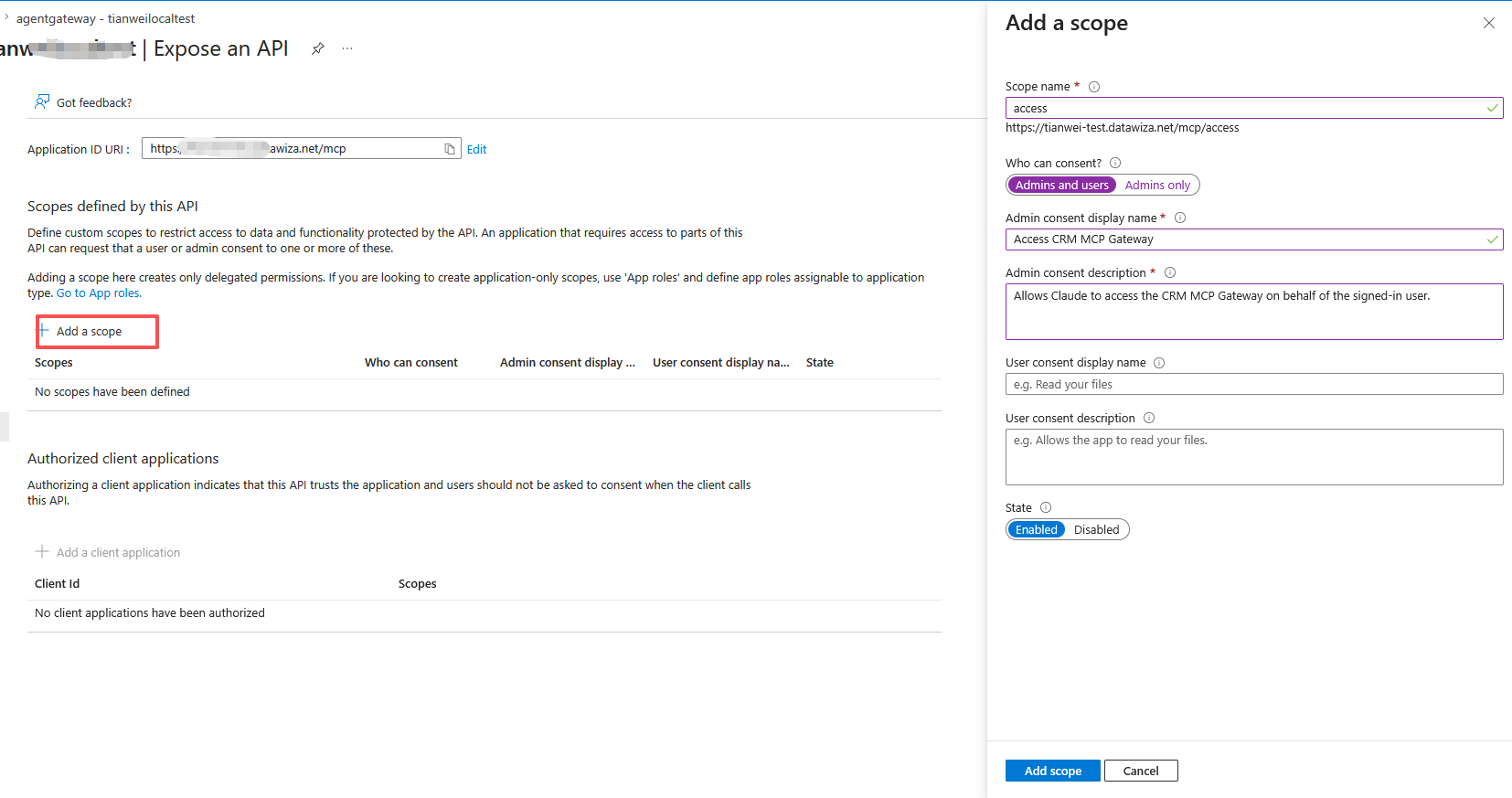
1.2 Register the Client App
This is the app ChatGPT actually signs users into.
Click New registration again and fill in:
Field Value Name ChatGPT CRM MCP ClientSupported account types Single tenant Redirect URI Leave blank for now ChatGPT's custom connector form lets you register your own OAuth client, and doesn't require a client secret — so it authenticates as a public client using authorization code + PKCE rather than a confidential client. You'll register its redirect URI under the Mobile and desktop applications platform in Step 3.1 — that platform is built for public clients and doesn't require a secret, unlike Web.
Redirect URI is unique per connector, not fixed
ChatGPT doesn't use one shared redirect URI across all custom connectors. Each connector gets its own callback URL (e.g.
https://chatgpt.com/connector/oauth/S2tqhGpwDpxd), generated when you configure OAuth for that connector in Step 3.1. That's why the Redirect URI is left blank here — you'll come back and add the connector-specific value once ChatGPT generates it.After the app is created, copy these values — you'll need the Tenant ID in Step 2 and the Client ID in Step 3:
Value Where to find it Tenant ID Overview page Client ID Overview page 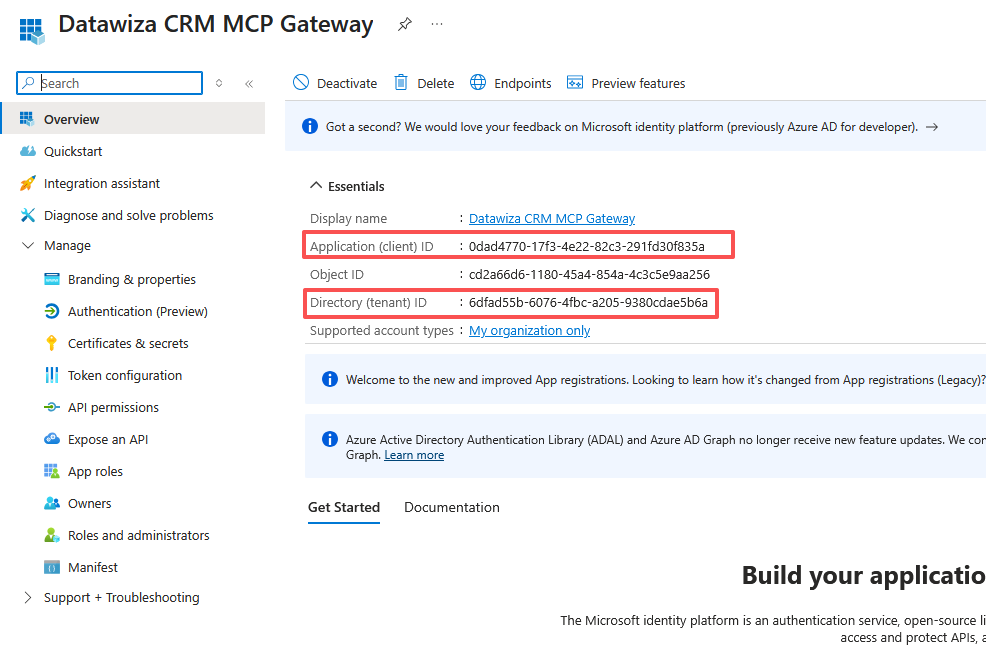
Grant this client app permission to request the resource app's scope:
- Go to API permissions > Add a permission > My APIs.
- Select the resource app (
Datawiza CRM MCP Gateway) from Step 1.1. - Choose Delegated permissions, check
access, then click Add permissions. - Click Grant admin consent for
<tenant>so users aren't individually prompted to consent, if your organization's policy allows it.
Step 2: Configure Datawiza Agent Gateway
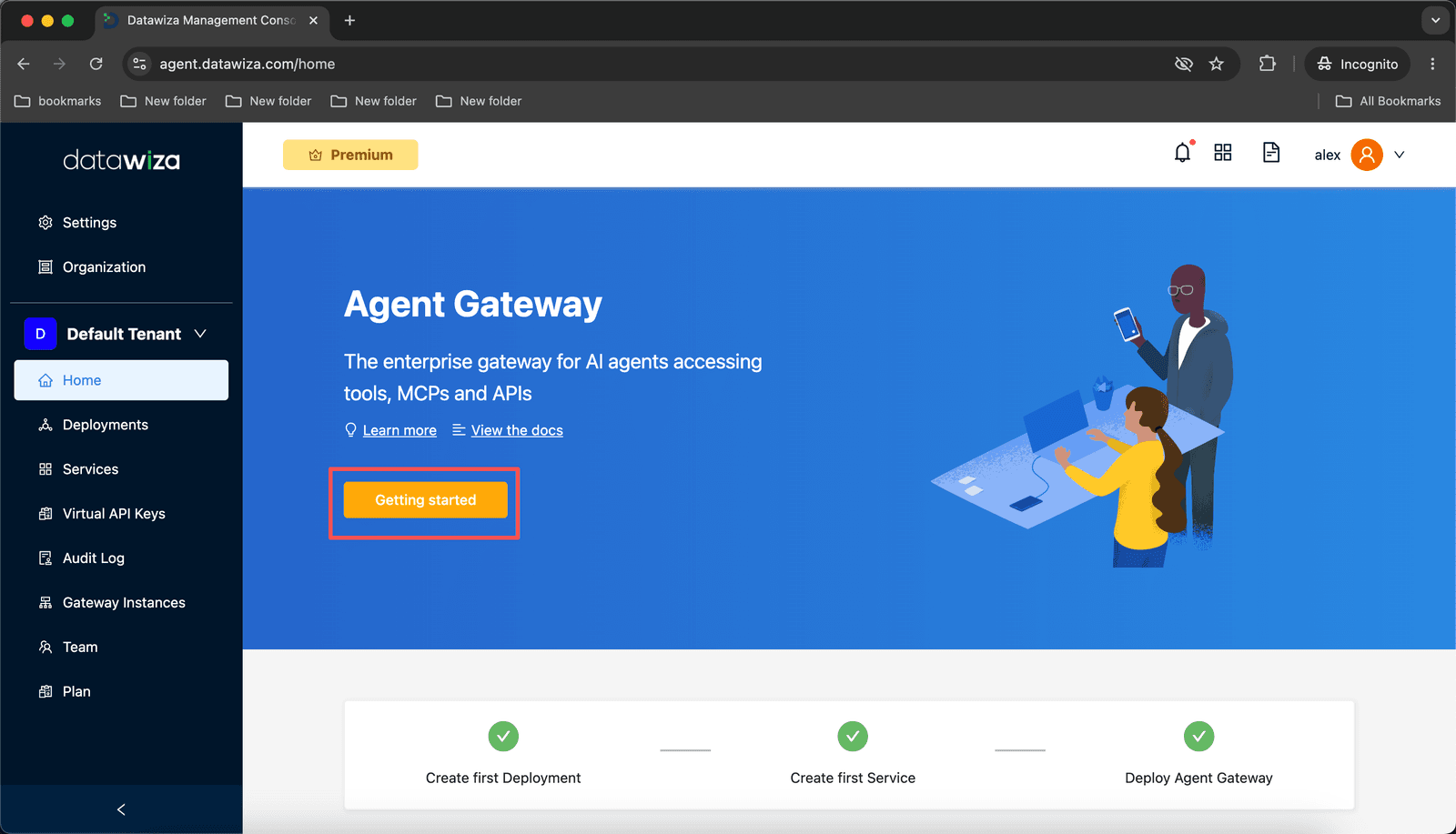
2.1 Sign in and click Getting Started
Log into Datawiza Agent Gateway Console (DAGC) and click the Getting Started button on the home page.
2.2 Name your Deployment
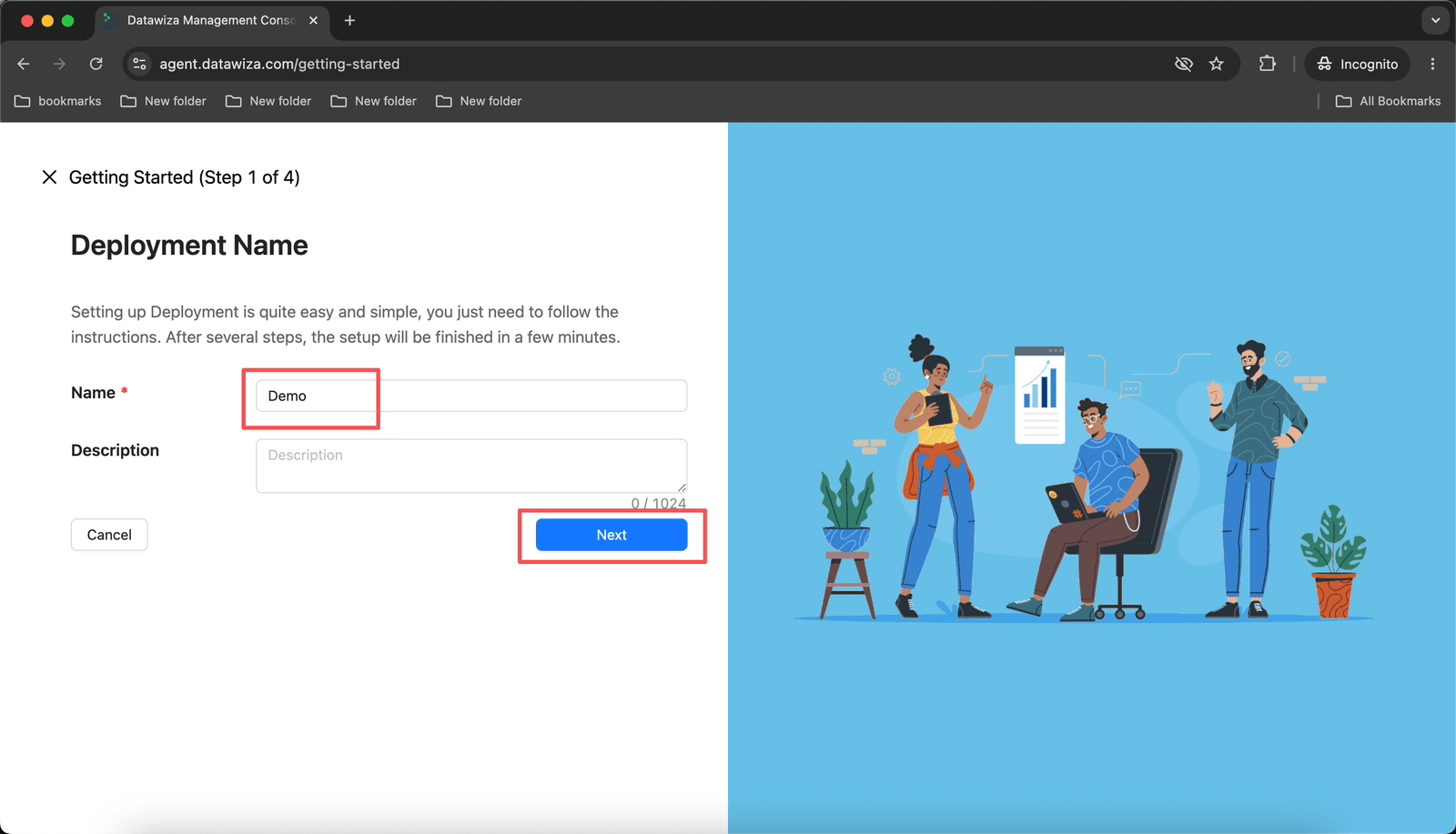
The Getting Started wizard opens at Step 1 of 4 — Deployment Name.
- Enter a
Namefor the deployment (e.g.,CRM MCP Gateway). - Click Next.
2.3 Add a Service
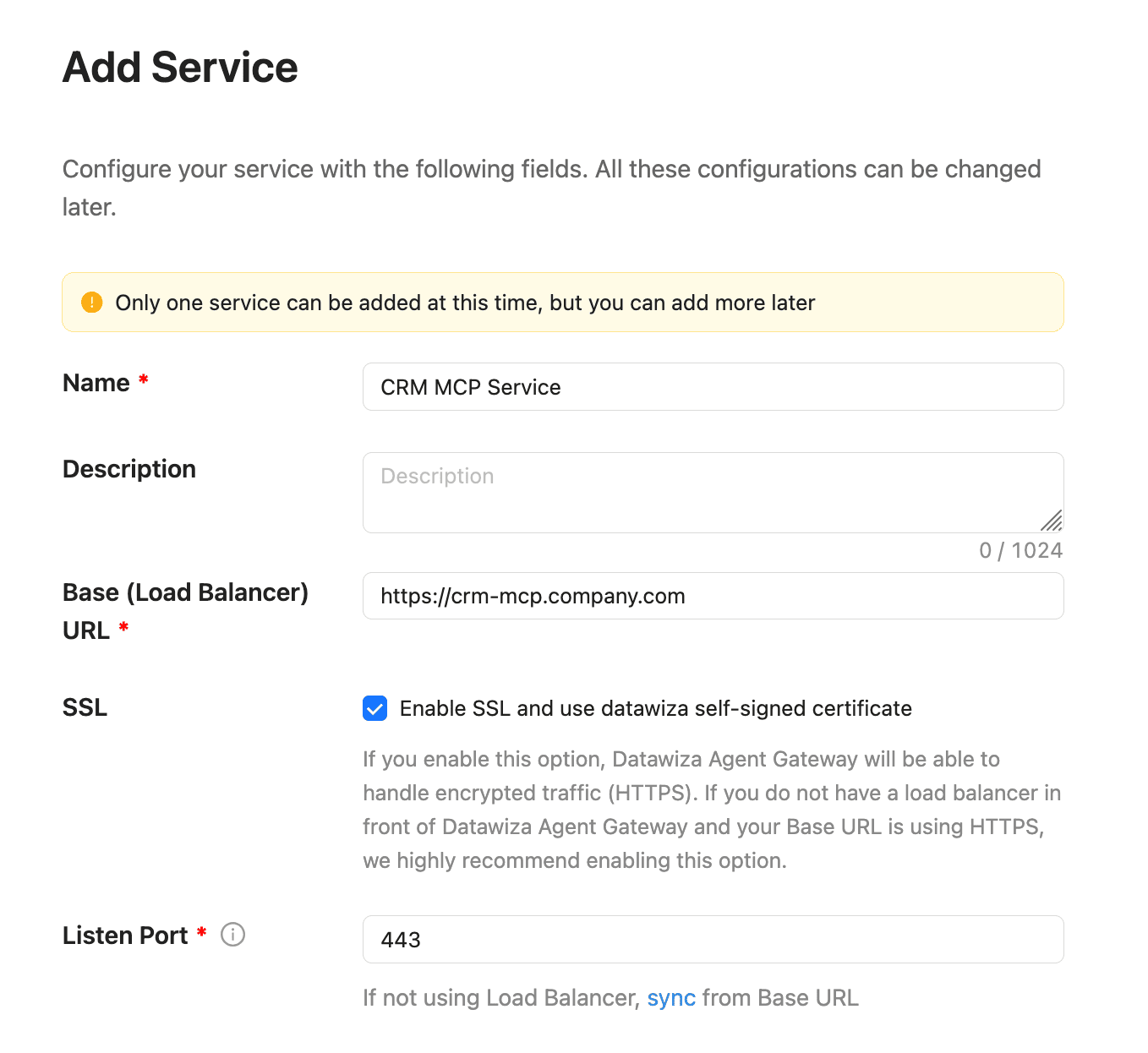
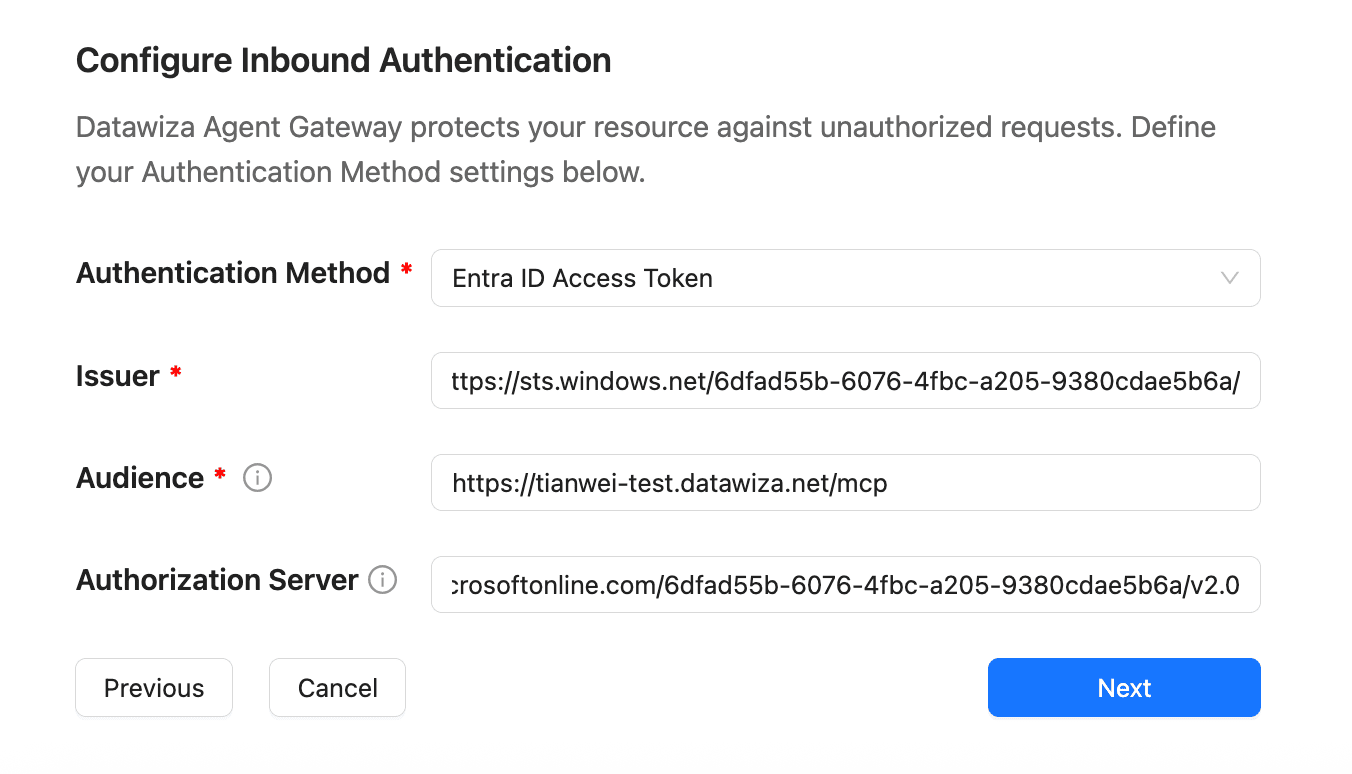
Step 2 of 4 — Service defines the public-facing MCP endpoint that ChatGPT connects to.
| Field | Value |
|---|---|
| Name | CRM MCP Service |
| Base (Load Balancer) URL | Your public gateway URL, e.g. https://crm-mcp.company.com |
| SSL | Enable — check Enable SSL and use datawiza self-signed certificate |
| Listen Port | 443 |
| Authentication Method | Entra ID Access Token |
| Issuer | https://sts.windows.net/<tenant-id>/ |
| Audience | https://crm-mcp.company.com/mcp (the resource app's Application ID URI from Step 1.1) |
| Authorization Server | https://login.microsoftonline.com/<tenant-id>/v2.0 (optional — fill it in only when it differs from the Issuer, as it does here) |
Click Next.
Why the Issuer isn't a v2.0 URL
The resource app registered in Step 1.1 defaults to issuing v1.0 access tokens — its manifest's requestedAccessTokenVersion is null unless you explicitly set it to 2. v1.0 tokens carry the issuer https://sts.windows.net/<tenant-id>/, not the v2.0-style https://login.microsoftonline.com/<tenant-id>/v2.0. Authorization Server is unrelated to the iss claim check — it's the v2.0 metadata endpoint DAGC uses to fetch Entra ID's signing keys and validate the token's signature.
ChatGPT rejects self-signed certificates
The wizard only offers the Datawiza self-signed certificate, and ChatGPT rejects it. After deploying in Step 2.5, replace it with a trusted CA certificate — see Step 2.6.
2.4 Add a Backend
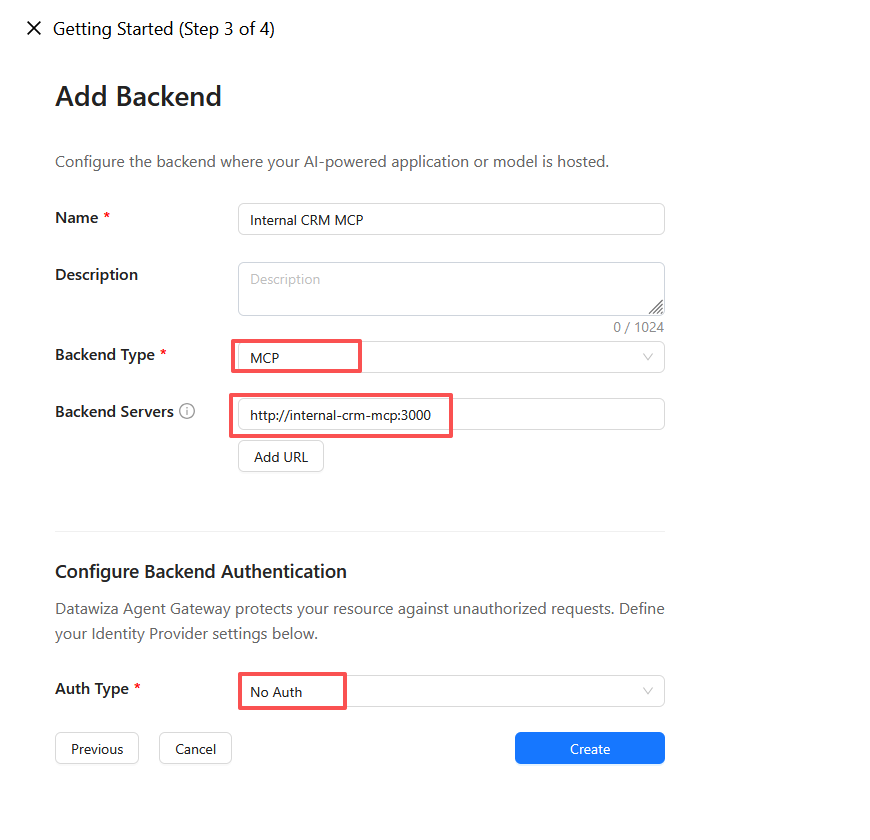
Step 3 of 4 — Backend points the gateway at your existing internal MCP server.
| Field | Value |
|---|---|
| Name | Internal CRM MCP |
| Type | MCP |
| Backend Servers | http://internal-crm-mcp:3000 |
| Auth type | No Auth |
Click Create.
2.5 Deploy the Gateway
Step 4 of 4 — Deploy shows your provisioning credentials and the startup commands.
Note the Provisioning Key and Provisioning Secret shown at the top.
Run the two commands on your gateway host:
# Install Docker and pull the Datawiza Agent Gateway image
curl https://datawiza.s3.us-west-2.amazonaws.com/datawiza-dag-env-prep.sh | sh

# Start Datawiza Agent Gateway
curl -s https://datawiza.s3.us-west-2.amazonaws.com/datawiza-dag-docker-compose-prep.sh \
  | bash -s -- -k <PROVISIONING_KEY> -s <PROVISIONING_SECRET> -p 443 \
  && sudo docker compose up -d
Click Done.
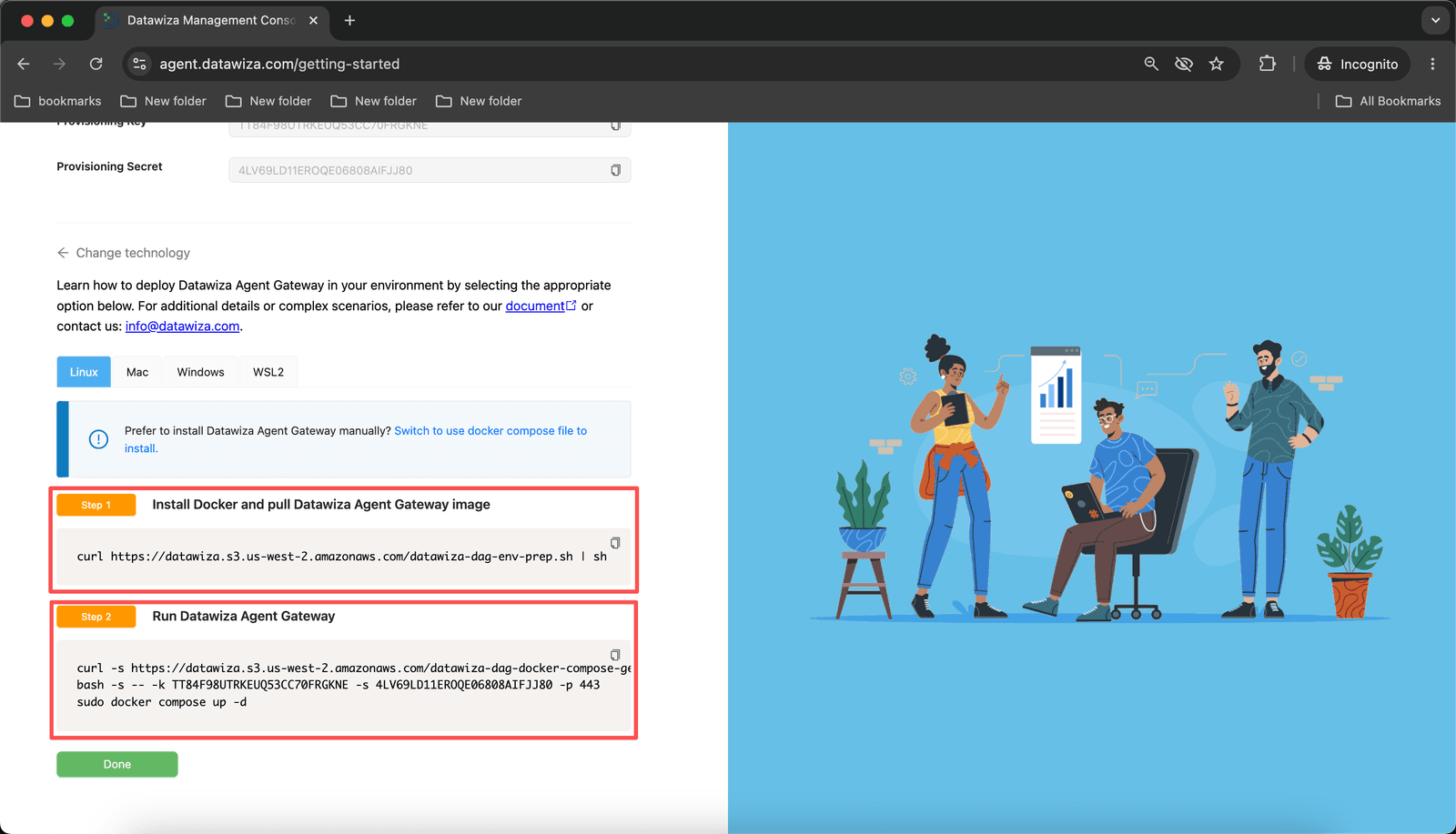
The gateway pulls its full configuration from DAGC automatically.
2.6 Replace the Self-Signed Certificate
The service is currently using the Datawiza self-signed certificate from Step 2.3. Before connecting ChatGPT, replace it with a certificate from a trusted CA by following SSL Certificates in Datawiza Agent Gateway: go to Services in DAGC, open this service's Advanced tab, click Edit, then Update Certificate to upload your PEM-format certificate and private key.
Step 3: Add the Protected MCP Endpoint to ChatGPT
ChatGPT's connector setup lets you register your own OAuth client and pass in the Entra client's Client ID directly.
Developer mode may be required
Some ChatGPT plans and workspace configurations gate custom MCP connectors behind a Developer mode setting. If you don't see a way to create a custom connector, check your account or workspace settings for a Developer mode toggle — its exact location varies by plan and has changed over time, so check OpenAI's help center if it isn't where you expect.
ChatGPT desktop app
If you use the ChatGPT desktop app, complete this connector setup in the ChatGPT web version first — it isn't available from the desktop app's own settings.
3.1 Create the Connector
Go to Apps in your ChatGPT workspace or account settings, and click Create.
Fill in:
Field Value Name Internal CRM MCPConnection Server URL MCP Server URL https://crm-mcp.company.com/mcpAuthentication OAuthExpand Advanced OAuth settings and set Registration method to User-Defined OAuth Client. This tells ChatGPT to use your own Entra app registration instead of attempting Dynamic Client Registration (DCR) or a Client Identifier Metadata Document (CIMD) — Datawiza Agent Gateway's protected endpoint doesn't advertise support for either.
Copy the Callback URL shown in this panel (e.g.
https://chatgpt.com/connector/oauth/S2tqhGpwDpxd) — ChatGPT generates it specifically for this connector.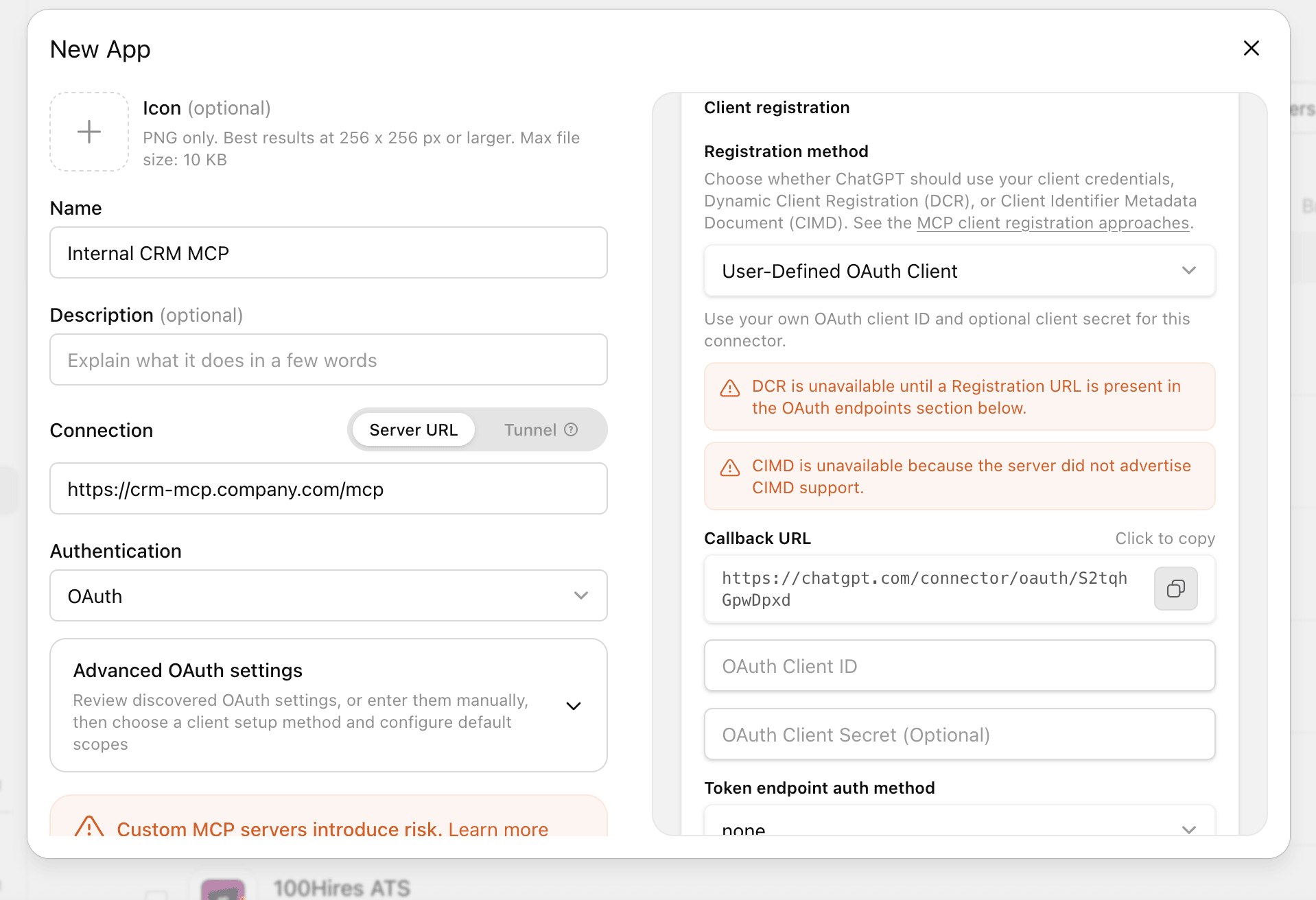
Register that callback URL in Entra before continuing:
- In the Azure portal, open
ChatGPT CRM MCP Client> Authentication. - Click Add a platform > Mobile and desktop applications, paste the callback URL under Redirect URIs, and click Configure (or, if that platform already exists, click Add URI under it instead).
- Click Save.
- In the Azure portal, open
Back in ChatGPT, finish the Client registration panel:
Field Value OAuth Client ID The Client ID of ChatGPT CRM MCP Clientfrom Step 1.2OAuth Client Secret Leave blank — this is a public client Click Create.
On a ChatGPT Business or Enterprise workspace, a workspace admin also needs to publish the connector — from its detail page in the Apps admin console — before it's available to use. Publishing rolls it out to the whole organization, so individual users don't need to configure it themselves.
Step 4: Verify Unauthenticated Access Is Blocked
Before testing with ChatGPT, confirm the gateway is rejecting unauthenticated requests:
curl -ik https://crm-mcp.company.com/mcp
Expected response:
HTTP/1.1 401 Unauthorized
This confirms that Datawiza is intercepting traffic and no unauthenticated request can reach the backend MCP server.
Step 5: Sign In with Microsoft Entra ID
When you finish creating the connector, ChatGPT immediately starts the Entra ID sign-in flow using the Client ID you entered. Datawiza validates the resulting access token on every request.
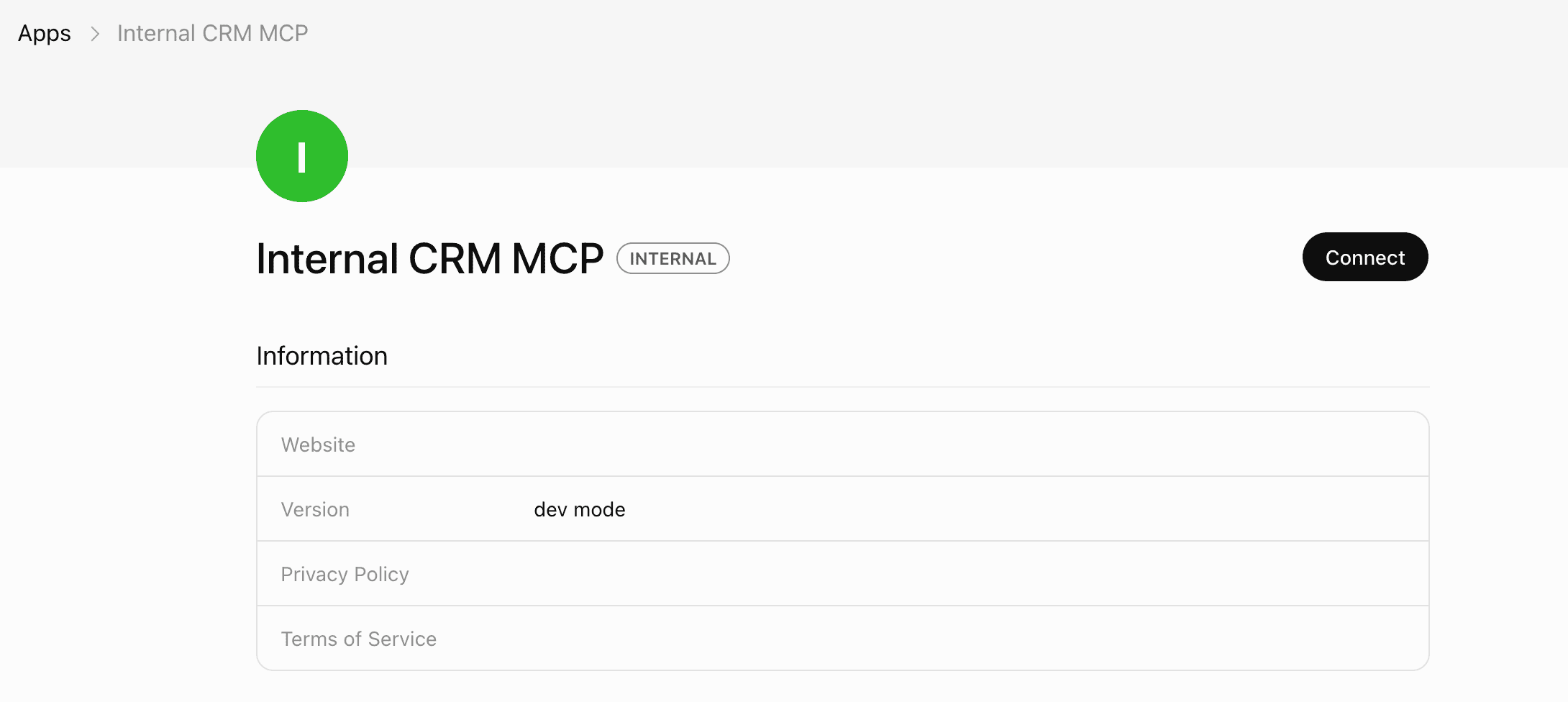
ChatGPT opens a browser popup prompting you to authenticate.
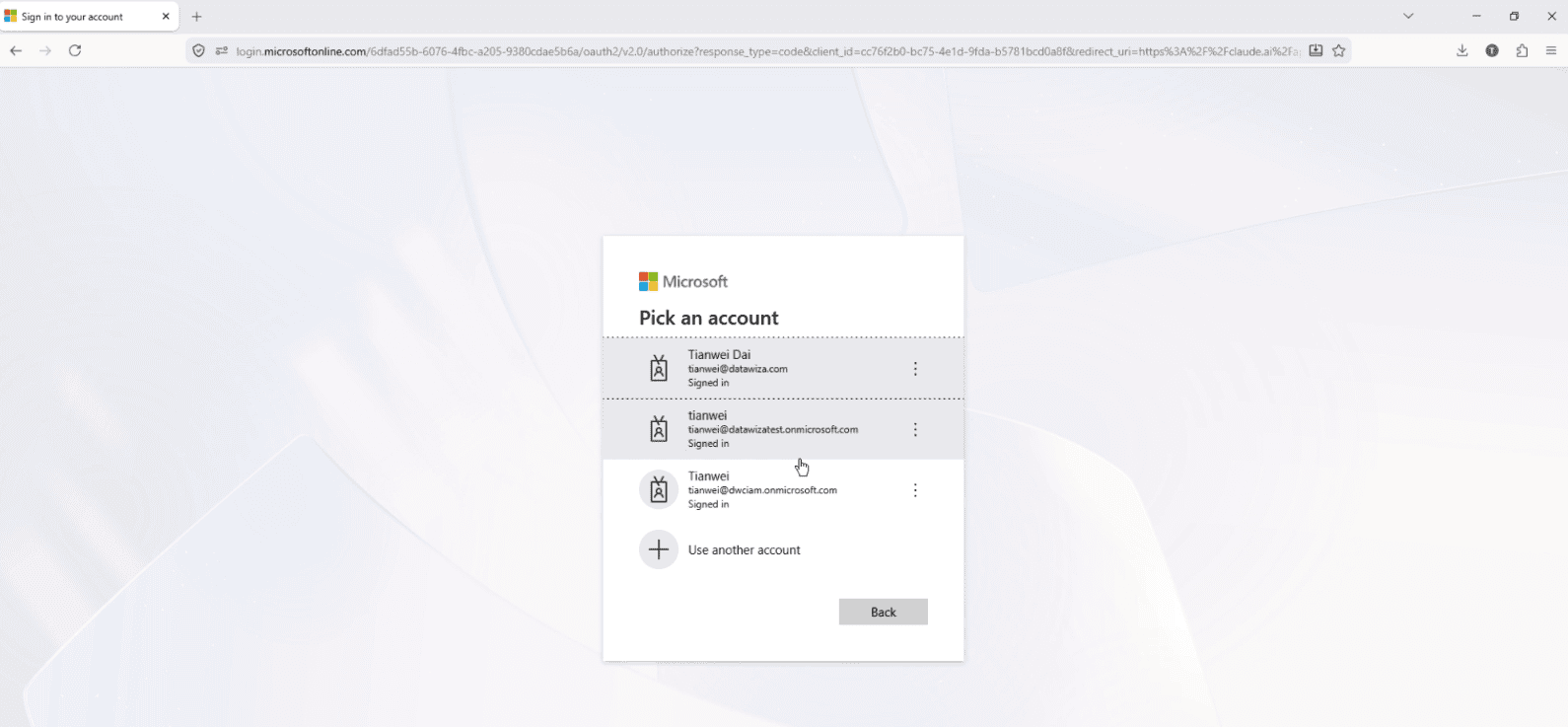
The popup redirects to the Microsoft Entra ID login page. Sign in with your enterprise account.
After a successful sign-in, Entra ID redirects back to the connector's callback URL you registered in Step 3.1 (e.g.
https://chatgpt.com/connector/oauth/S2tqhGpwDpxd). ChatGPT stores the access token and attaches it as a bearer token to each MCP request. Datawiza validates the token — checking the issuer and the MCP endpoint audience — before forwarding the request to the backend.ChatGPT shows the connector as Connected, and its tools become available to attach in a chat.
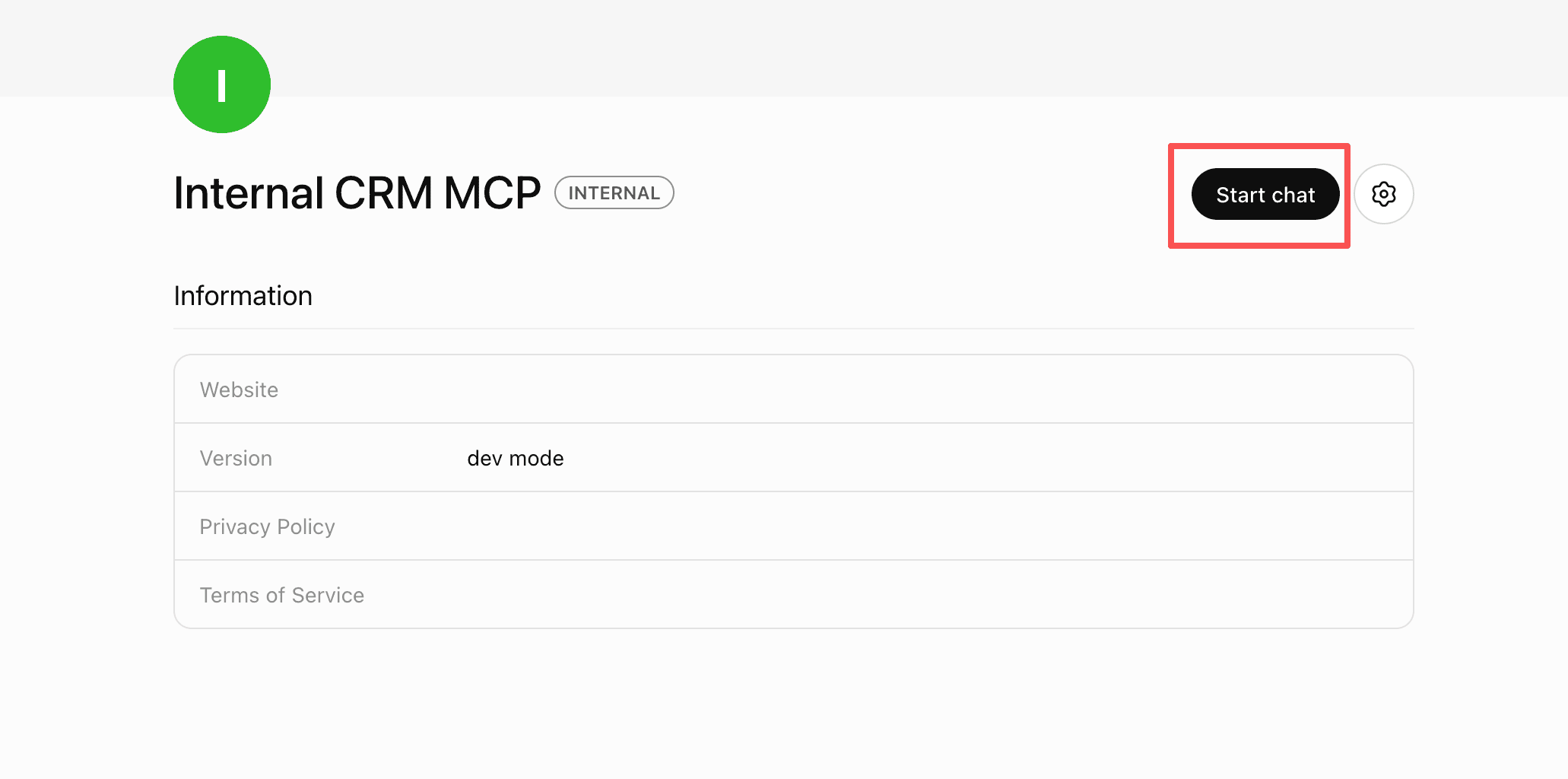
Once connected, ChatGPT can call MCP tools for the duration of the session. An expired or missing token returns 401 Unauthorized and triggers a new login prompt the next time the connector is used.
Step 6: Call MCP Tools from ChatGPT
With the MCP server connected, attach it to a chat and test tools to confirm end-to-end authentication is working.
- Start a new chat in ChatGPT.
- Click the + icon next to the message box, select More, and choose the Internal CRM MCP connector.
Get a customer profile
In ChatGPT, type:
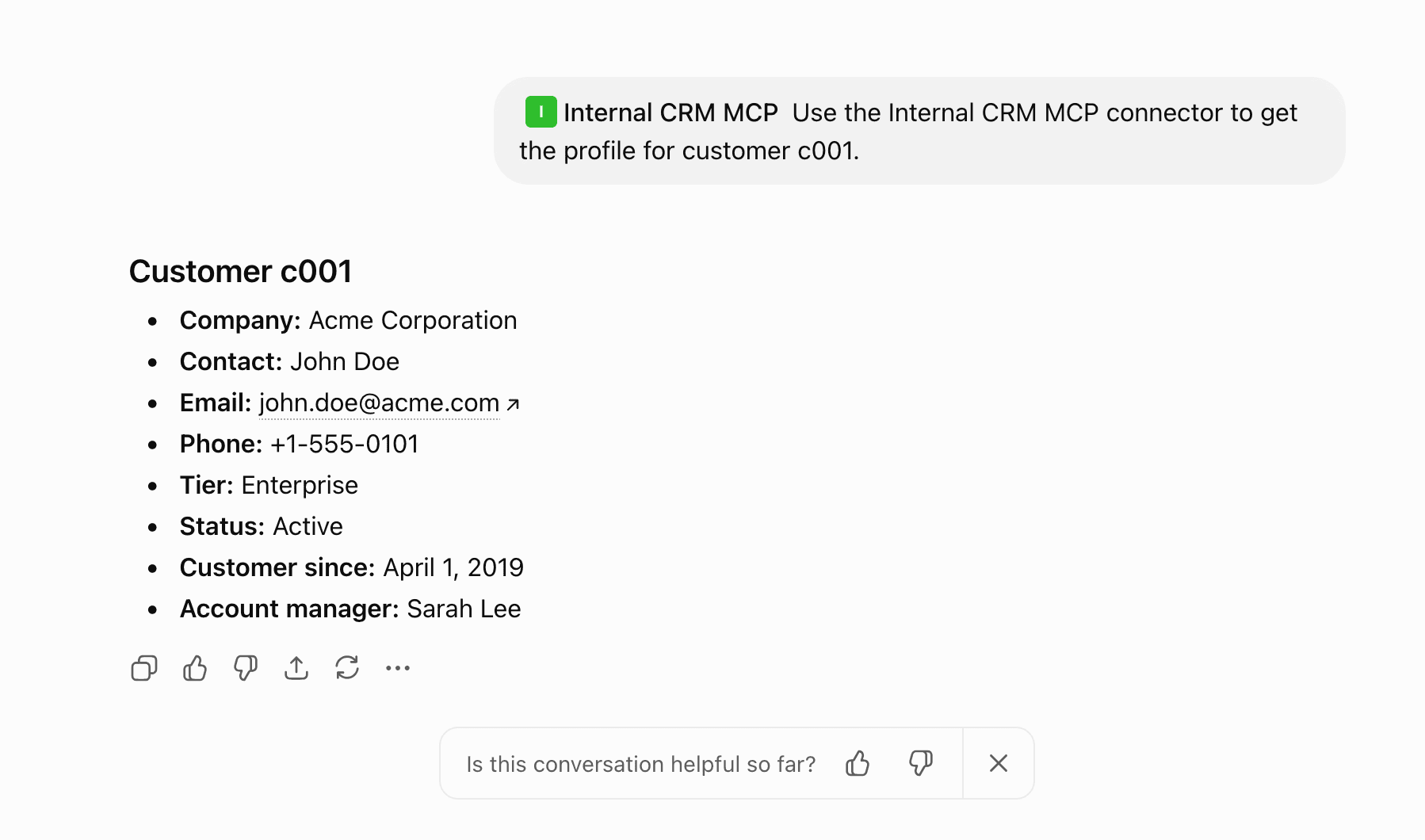
Use the Internal CRM MCP connector to get the profile for customer c001.
ChatGPT calls get_customer_profile and shows the result.
List customer orders
In ChatGPT, type:
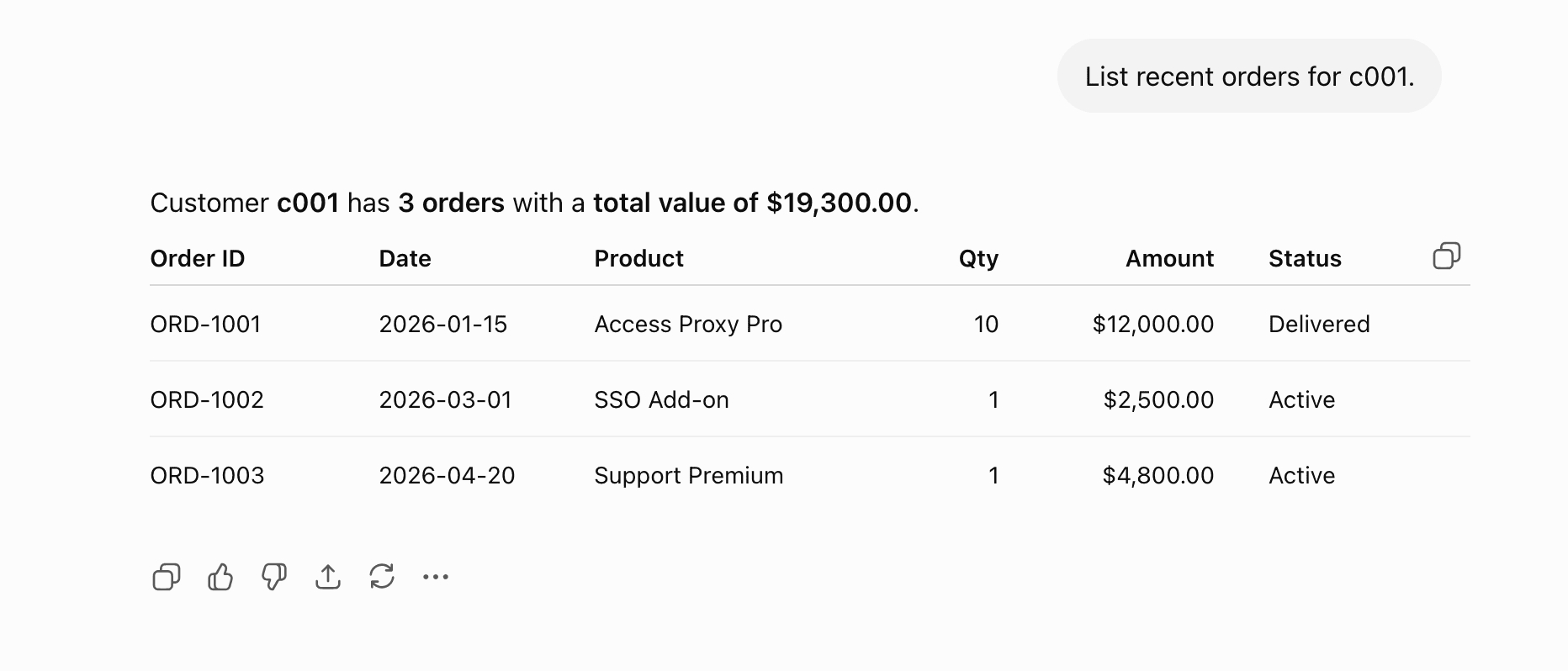
List recent orders for c001.
ChatGPT calls list_customer_orders and displays the order history.
Step 7: Verify Datawiza Logs and Audit Records
In DAGC, open the logs for your deployment and confirm the following events appear:
- User login event with the authenticated user's email
- Microsoft Entra ID authentication success
- Request allowed or denied based on policy
- Request forwarded to the backend MCP server
- MCP tool call recorded with user context
This confirms that Datawiza is acting as the authentication, identity, and policy enforcement layer for all ChatGPT-to-MCP traffic.
Summary
Your MCP server stays simple — it exposes tools for ChatGPT without implementing enterprise OAuth. Datawiza Agent Gateway becomes the front door: it handles Microsoft Entra ID login, validates tokens, enforces access policy, and forwards only authenticated traffic to the backend.
This separation of concerns means MCP server developers can focus on building useful tools, while identity and access control remain owned by the teams responsible for them. The same pattern applies to any internal MCP server — CRM, HR, finance, ticketing, or internal APIs — without changing a line of server code.
ChatGPT users get a seamless experience: they authenticate once with their enterprise Entra ID credentials, and all MCP tools become available for the session. Unauthenticated or unauthorized requests never reach the backend.
Related Resources
- Datawiza Agent Gateway Introduction
- SSL Certificates in Datawiza Agent Gateway
- Entra ID Auth for Claude MCP Servers with Datawiza Agent Gateway
- Anthropic API Proxy for Claude with Datawiza Agent Gateway
- Microsoft Entra ID — Register an application
- Microsoft Entra ID — Configure app to expose a web API
- OpenAI — Developer mode and MCP apps in ChatGPT